


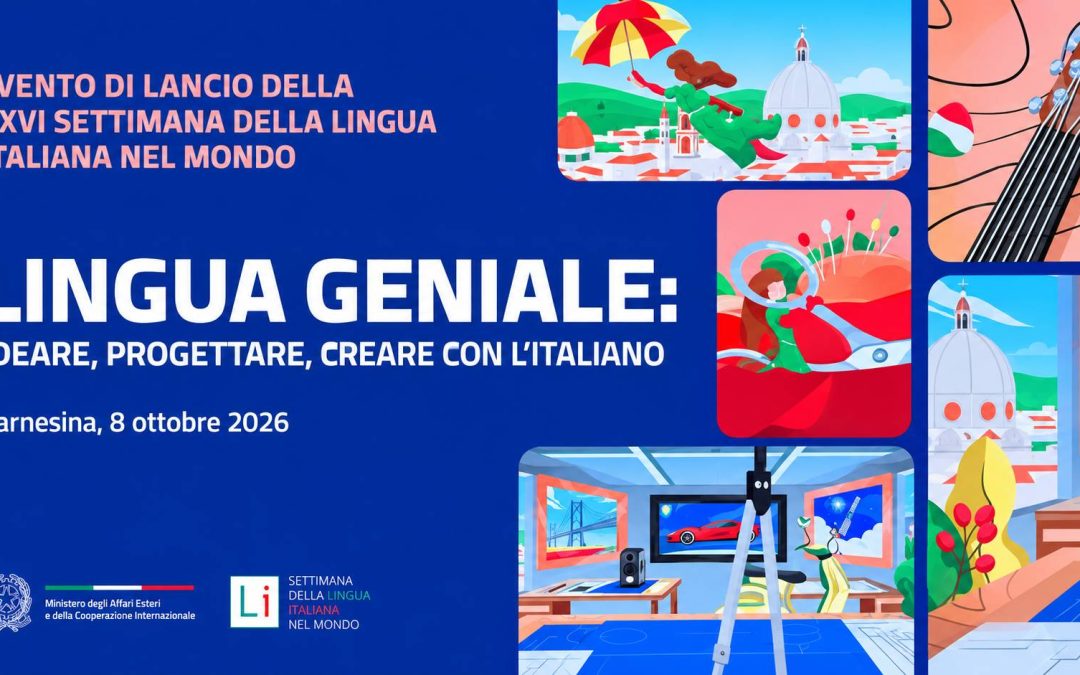
On 8 October 2026, ASILS President Alessandro Vidoni and Vice President Francesca Romana Memoli represented the Association at a meeting held at the Italian Ministry of Foreign Affairs and International Cooperation, ahead of the Week of the Italian Language in the World.
The meeting provided an important opportunity to exchange ideas on the promotion and dissemination of Italian internationally. It also offered a chance to explore how ASILS can contribute to these efforts and strengthen recognition of the role played by its member schools.
The Week of the Italian Language in the World 2026
The 26th Week of the Italian Language in the World, taking place from 19 to 25 October 2026, is dedicated to the theme “Lingua geniale: ideare, progettare, creare con l’italiano” — exploring Italian as a language of ideas, design and creativity.
This year’s theme highlights the relationship between the Italian language, cultural expression and the country’s capacity for innovation. From science and engineering to design, fashion, gastronomy, literature and art, Italian provides access to the knowledge and skills that shape Italy’s contribution to the world.
Organised by Italy’s diplomatic and consular network and the Italian Cultural Institutes, in collaboration with partners involved in language promotion, the Week brings together conferences, exhibitions, discussions and cultural events around a shared annual theme. Established in 2001, the initiative receives the High Patronage of the President of the Italian Republic each year.
An Opportunity for Dialogue with Institutions
For ASILS, the meeting at the Farnesina offered a valuable setting in which to discuss the international promotion of Italian and reflect on the contribution of its member schools.
The participation of Alessandro Vidoni and Francesca Romana Memoli provided an opportunity to consider how the Association’s experience can support wider language promotion initiatives and help highlight the work carried out by schools teaching Italian to international students.
Dialogue with institutions helps connect the everyday experience of language education with broader cultural objectives. Schools work directly with learners of different nationalities, ages and backgrounds, offering a valuable perspective on why people choose to study Italian and what they hope to achieve through it.
Italian Language Schools as Places of Cultural Exchange
Learning Italian in Italy means engaging with the country’s daily life as well as its language. Classroom learning is complemented by opportunities to discover local communities, explore cultural heritage and use Italian in real situations.
Language schools help students build these connections. By welcoming learners and supporting their progress, they create opportunities for communication, participation and exchange across cultures.
This experience gives language learning a lasting personal dimension. Conversations, encounters and shared activities allow students to develop a closer understanding of Italy and build relationships that can continue after they return home.
Italian as a Language of Ideas and Creativity
The theme of the 2026 edition has particular relevance for language education. Learning Italian can open doors to the ideas, projects and expertise expressed through the country’s cultural, scientific and professional life.
Students may approach Italian through an interest in art, music, fashion, design or food, or because of academic, professional or personal goals. Language schools help transform these interests into opportunities for learning and discovery.
By connecting language study with authentic materials and direct experience, schools can make Italy’s cultural and creative heritage more accessible to international audiences.
Recognising the Contribution of ASILS Member Schools
The meeting on 8 October offered ASILS an opportunity to reflect on how to bring greater visibility to its member schools within the wider promotion of Italian worldwide.
Their daily work makes a practical contribution to this shared objective. Each learning experience develops language skills, encourages cultural understanding and creates connections between Italy and the students who choose to study here.
The presence of President Alessandro Vidoni and Vice President Francesca Romana Memoli at the Farnesina reflects the Association’s attention to institutional dialogue and to recognising the role of its member schools in promoting the Italian language and culture internationally.
For further information about the theme and initiative, visit the official page of the Week of the Italian Language in the World on the website of the Italian Ministry of Foreign Affairs and International Cooperation.
