


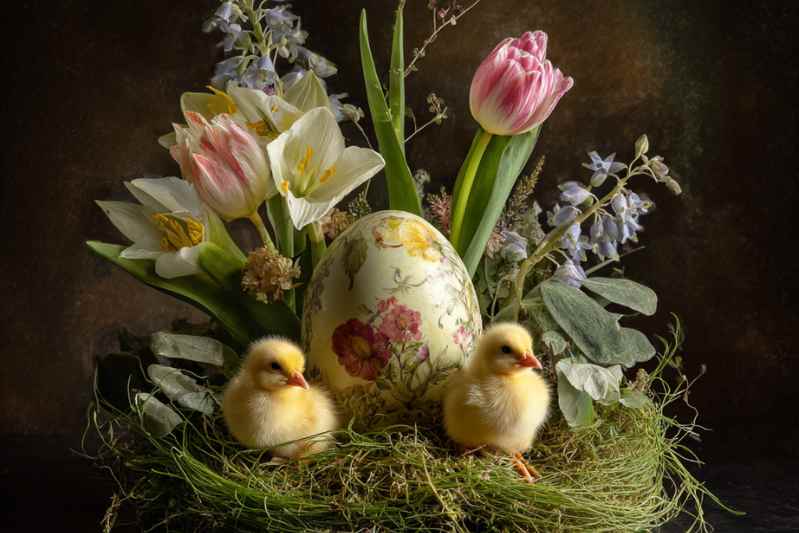
Easter in Italy is not only a religious celebration, but a moment when everyday life, language and cultural habits become especially visible — offering international students a unique way to experience the country from within.
Across Italy, Easter reflects a balance between shared traditions and local identities. It is one of those periods when cultural patterns become clear: family structures, social habits, food rituals and even ways of speaking.
For schools of Italian as a foreign language, this makes Easter particularly relevant. Organisations such as ASILS promote an approach where language is not separated from culture, but experienced through real-life contexts.
🐣 A National Tradition with Hidden Stories

Some Easter traditions are shared throughout Italy, but their origins are not always as ancient as one might expect. The famous colomba, for example, is often perceived as a traditional recipe, yet it was actually popularised in the 1930s as a commercial adaptation of panettone.
Chocolate eggs, on the other hand, reflect a more modern and distinctly Italian habit: unlike in many countries, where eggs are small and decorative, in Italy they are often large, wrapped in colourful foil and contain a surprise — a detail that has become part of everyday conversation, especially among children.
These elements show how Italian traditions are often a mix of history, innovation and social habits, rather than fixed or purely historical customs.
🗺️ From North to South: Different Ways of Experiencing Easter

The way Easter is experienced varies significantly across Italy. In the north, celebrations tend to be more private and centred on family meals. In central regions, historical traditions often blend with local identity.
In southern Italy, Easter frequently becomes a collective and highly emotional event. Processions and rituals are not simply religious acts, but moments of strong community participation that reveal the social fabric of the territory.
For students, this diversity offers a valuable insight: understanding Italy means understanding its regional differences, not just its national identity.
🗣️ Language in Context: Words You Actually Hear
Easter is also a moment when specific vocabulary naturally appears in everyday interactions. However, what makes it particularly interesting for learners is not only the words themselves, but how they are used in real-life situations.
- Pasqua – often used in greetings: “Buona Pasqua!”
- Pasquetta – commonly associated with plans: “Cosa fai a Pasquetta?”
- Uovo di Pasqua – linked to surprise and gift culture
Beyond vocabulary, Easter is also rich in expressions and idiomatic language. Exploring these phrases helps learners better understand how Italians communicate in informal and cultural contexts.
🎯 Try it: Easter idioms and expressions
Test your understanding of Italian Easter-related expressions and discover how language reflects culture.
This type of activity shows how vocabulary is embedded in social interaction, making language learning more dynamic and connected to real cultural experiences.
🌿 Pasquetta: A Social Ritual

While Easter Sunday is traditionally family-oriented, Pasquetta represents something different. It is often described as a “day off within a holiday”, dedicated to friends, informal gatherings and outdoor activities.
For many Italians, it is one of the first real moments of spring, marking a transition not only in the season, but also in social behaviour — from private to collective life.
✨ Experience Italian Language and Culture First-Hand
Through the network of ASILS schools , students can experience Italian not only as a language, but as a living cultural system.
